Saving Small Restaurants from Digital Busywork
Product Designer
5 months
Restaurant SaaS
8 people
I designed Menu Pulse to give small restaurant owners their time back. As the sole product designer, I led research, strategy, and end-to-end design for a 5-month 0→1 build, reducing daily digital tasks from 90 minutes to 30 minutes, increasing menu updates from monthly to weekly, and shipping to 54 beta restaurants with a 94% task completion rate.
Sole product designer on an 8-person team. 0→1 build, no prior design work to inherit.
8 people: 1 PM, 1 designer (me), 5 engineers, 1 QA. I collaborated daily with PM on scope tradeoffs and engineering on API limitations that shaped our design approach.
Menu Pulse is a digital optimizer designed to help small restaurants manage menus, reviews, and online presence from one dashboard. Unlike enterprise tools built for large chains, it targets independent owners with 1–3 locations who handle their own marketing.
The challenge was operational. Owners were spending 1–2 hours daily on repetitive digital tasks: updating menus across platforms, responding to scattered reviews, and trying to understand what was working. They were not running their restaurants. They were running their platforms.
The tools existed. The time did not.
Owners knew their online presence mattered but could not maintain it alongside daily operations.
Outdated menus led to customer complaints, negative reviews, and lost trust.
Owners avoided responding because they did not know what to say, especially to negative feedback.
The market gap was clear. Enterprise tools like Yelp and OpenTable charged $1,000+/month or took 20–30% per order. Simple tools solved only one piece. Nothing combined AI-powered content creation, cross-platform publishing, and unified review management for small restaurants at an accessible price point.
If owners could not keep up digitally, they would lose customers to competitors who could. Menu Pulse needed to give them their time back.
To identify where time was being lost, I led a research effort combining qualitative interviews, surveys, and competitive analysis. Over three weeks, I conducted 12 owner interviews across family-run diners, fast-casual spots, and upscale bistros, observing them complete real tasks like updating a menu item, responding to a review, and checking performance metrics.
| Method | Count |
|---|---|
| Owner Interviews | 12 |
| Owner Surveys | 45 |
| Diner Surveys | 30 |
| Competitive Analysis | 4 platforms |
| Usability Testing | 3 rounds, 15 participants |
| Beta Testing | 54 restaurants |
A clear pattern emerged. Owners did not struggle because they lacked tools. They struggled because every task required switching contexts, logging into multiple platforms, and starting from scratch each time. The friction was not in any single step. It was in the repetition.
78% said lack of time is their #1 barrier to better online presence
Owners delay menu updates because writing descriptions feels hard and time-consuming
Negative reviews sit unanswered because owners do not know what to say
Owners abandoned tools that required more than 3 clicks to complete a task
Owners want AI assistance but need final approval before anything goes live
"I spend my mornings copying and pasting the same menu update to four different websites. By the time I'm done, lunch rush has started."
Bistro Owner, Ann Arbor
Platform API limitations restricted full automation
Yelp and TripAdvisor do not offer public APIs for menu updates or review responses. Rather than hiding this limitation, we designed assisted flows using deep-links and clipboard copying, making the workaround feel intentional, not broken.
Timeline required shipping core features in 8 weeks
Investor milestones demanded a working beta before full feature parity. We prioritized menu creation and review management over analytics, accepting that some users would want features we could not yet deliver.
Users distrusted fully automated AI content
Early testing showed owners rejected responses that posted without their input. We added tone selection and mandatory review steps, increasing task time but dramatically improving trust and adoption.
Multi-Location Architecture
"Building separate dashboards per location adds database complexity. Can we show all data in one view with filters?"
Testing revealed owners with 2–3 locations could not parse combined data. They needed clear separation to understand which restaurant was performing how. Filters added cognitive load.
We agreed on a hybrid approach: a location switcher in the header that loaded location-specific dashboards, with an optional "All Locations" view. Engineering built a shared component architecture that made adding future locations easier, and users got the clarity they needed.
Launch Without Usability Testing to Hit Deadline
"We're behind schedule. Testing will take two weeks we don't have. Let's ship and iterate based on real feedback."
Shipping untested flows risked higher support costs, negative first impressions, and rework that would cost more than testing upfront.
I proposed a compressed 5-day testing sprint, recruiting 5 participants, running 45-minute sessions, and synthesizing findings within 48 hours. We found 3 critical issues (business claiming, AI tones, multi-location) that would have caused significant friction. Stakeholders acknowledged the sprint was worth the delay.
I focused on five core problems that had the most strategic and user impact:
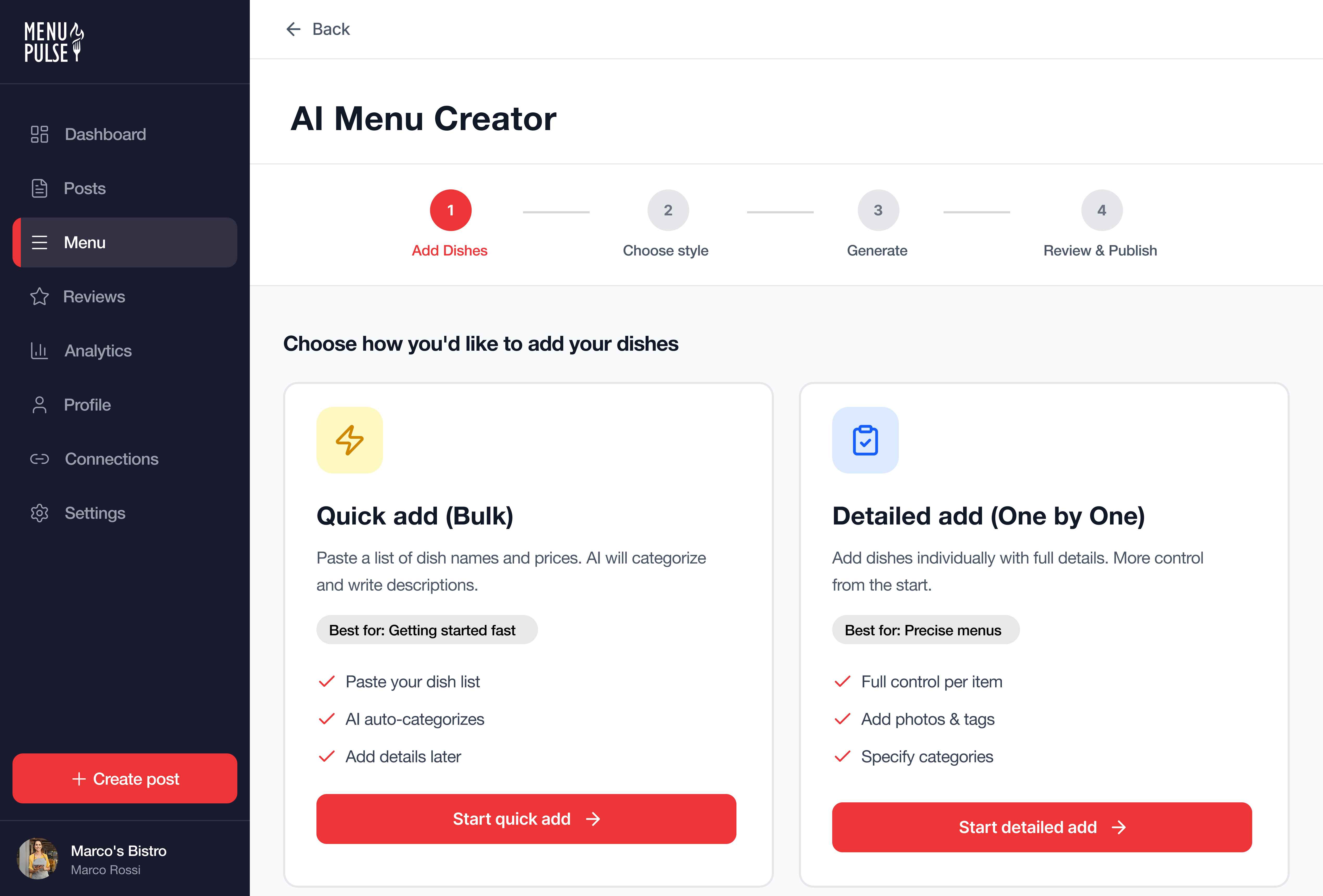
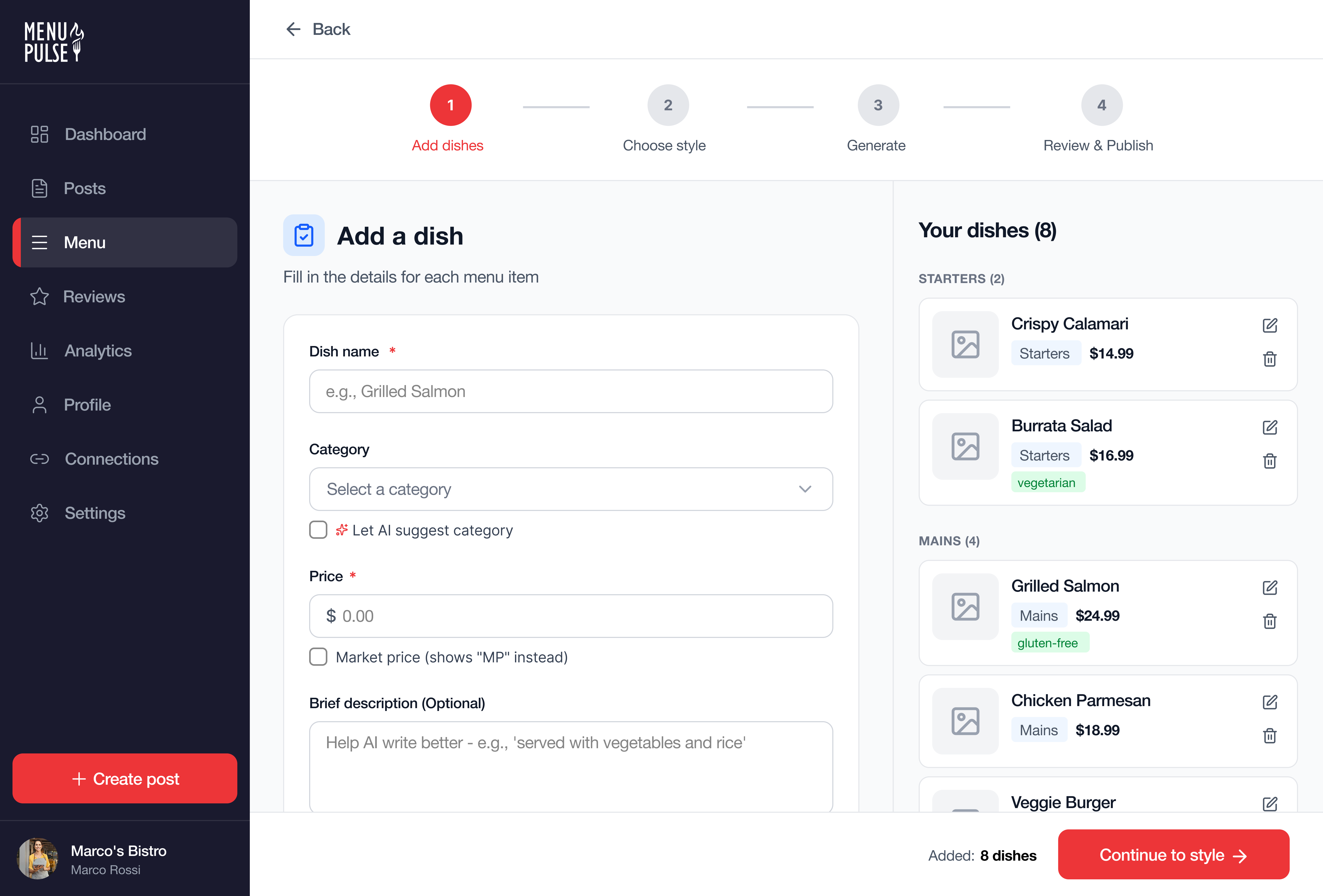
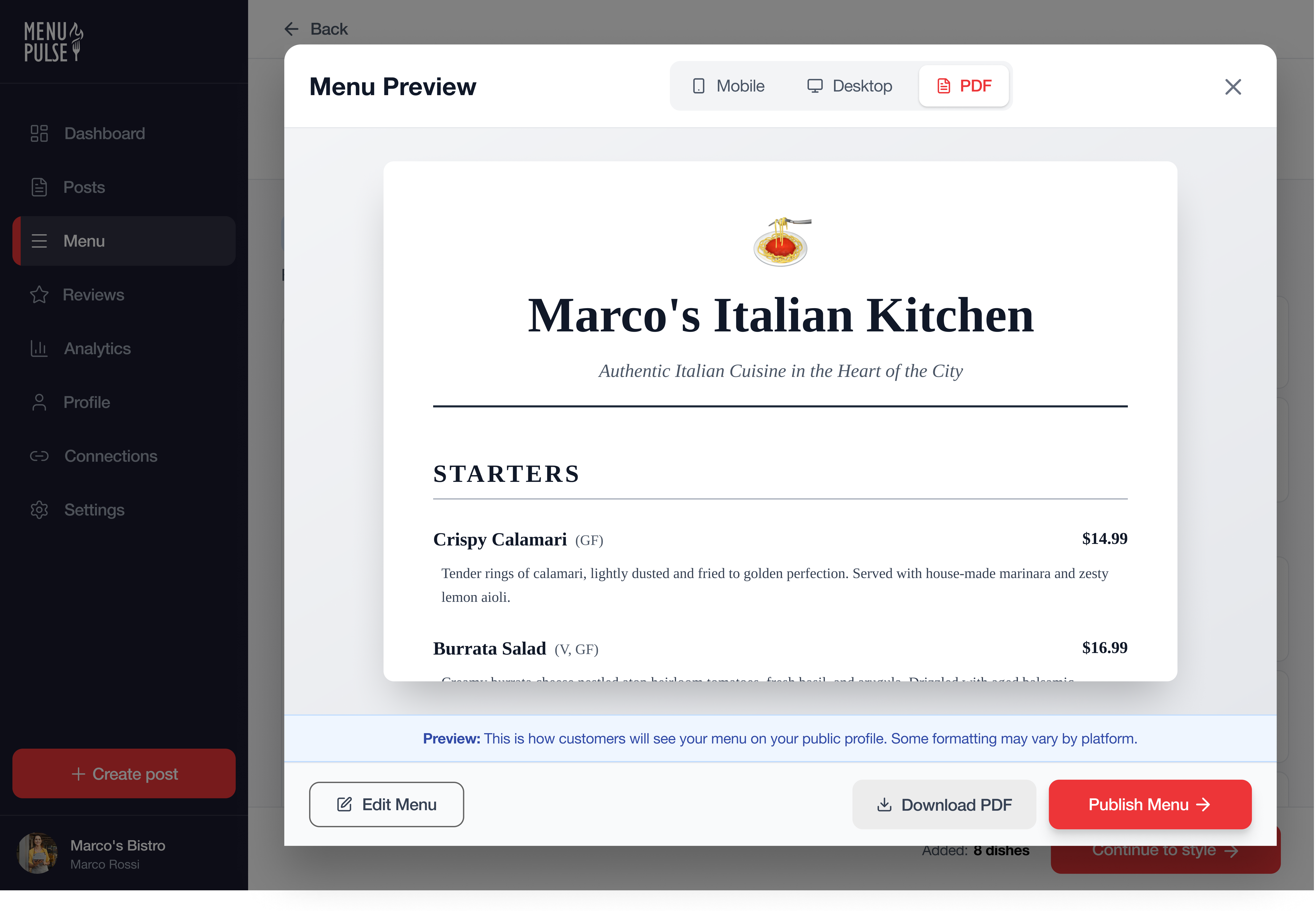
Menu descriptions stayed bland or missing because owners were not copywriters and did not have time to write compelling content for every dish. Updating menus meant logging into multiple platforms and repeating the same work.
To reduce friction without sacrificing quality, I designed an AI Menu Creator with two modes. Quick Add for bulk rewrites and Detailed Add for one dish at a time. Owners could choose a style, let AI generate descriptions, preview how the menu would look across devices, and publish directly.
Impact: Menu creation time dropped from 2+ hours to under 15 minutes. Update frequency increased from monthly to multiple times per week.
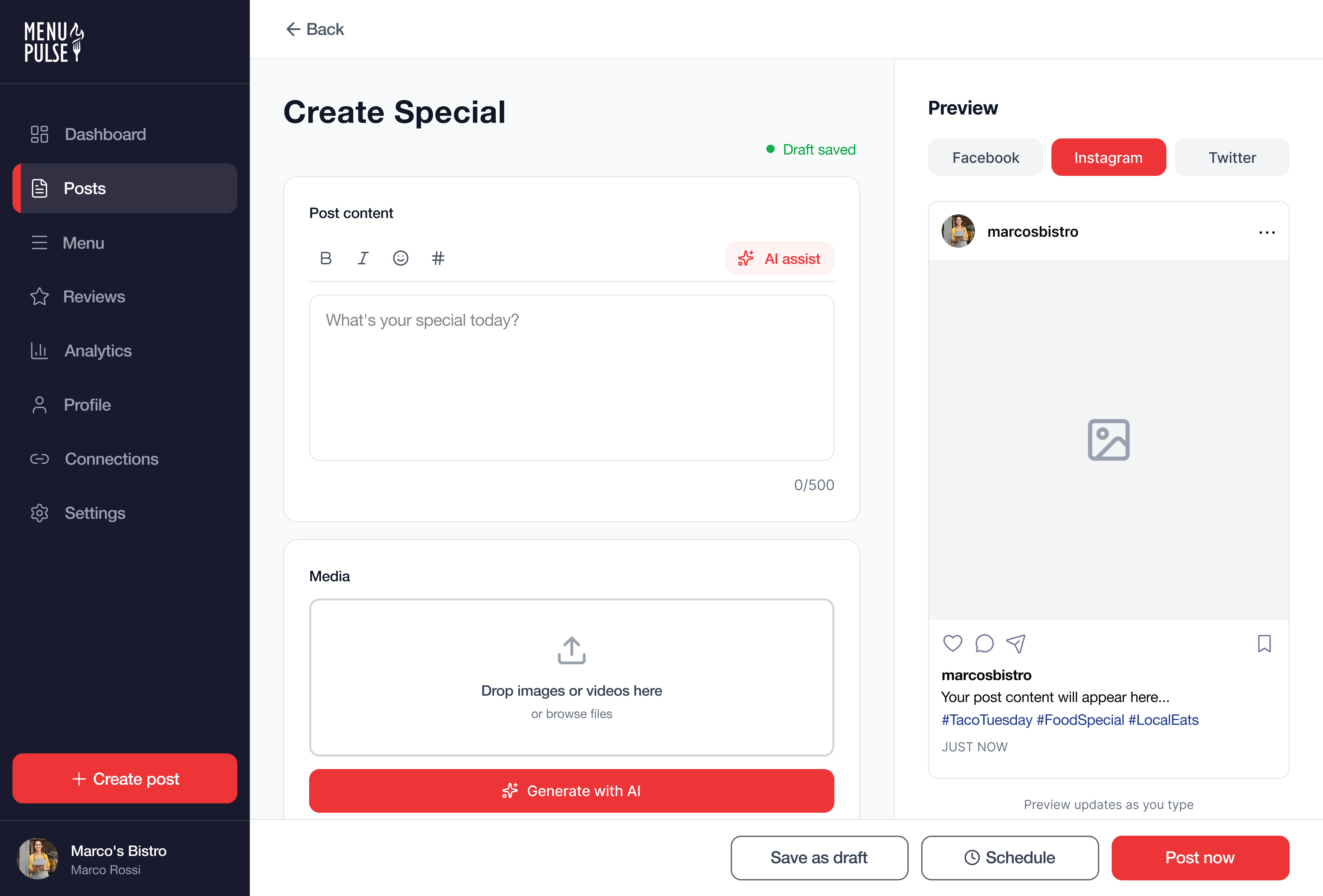
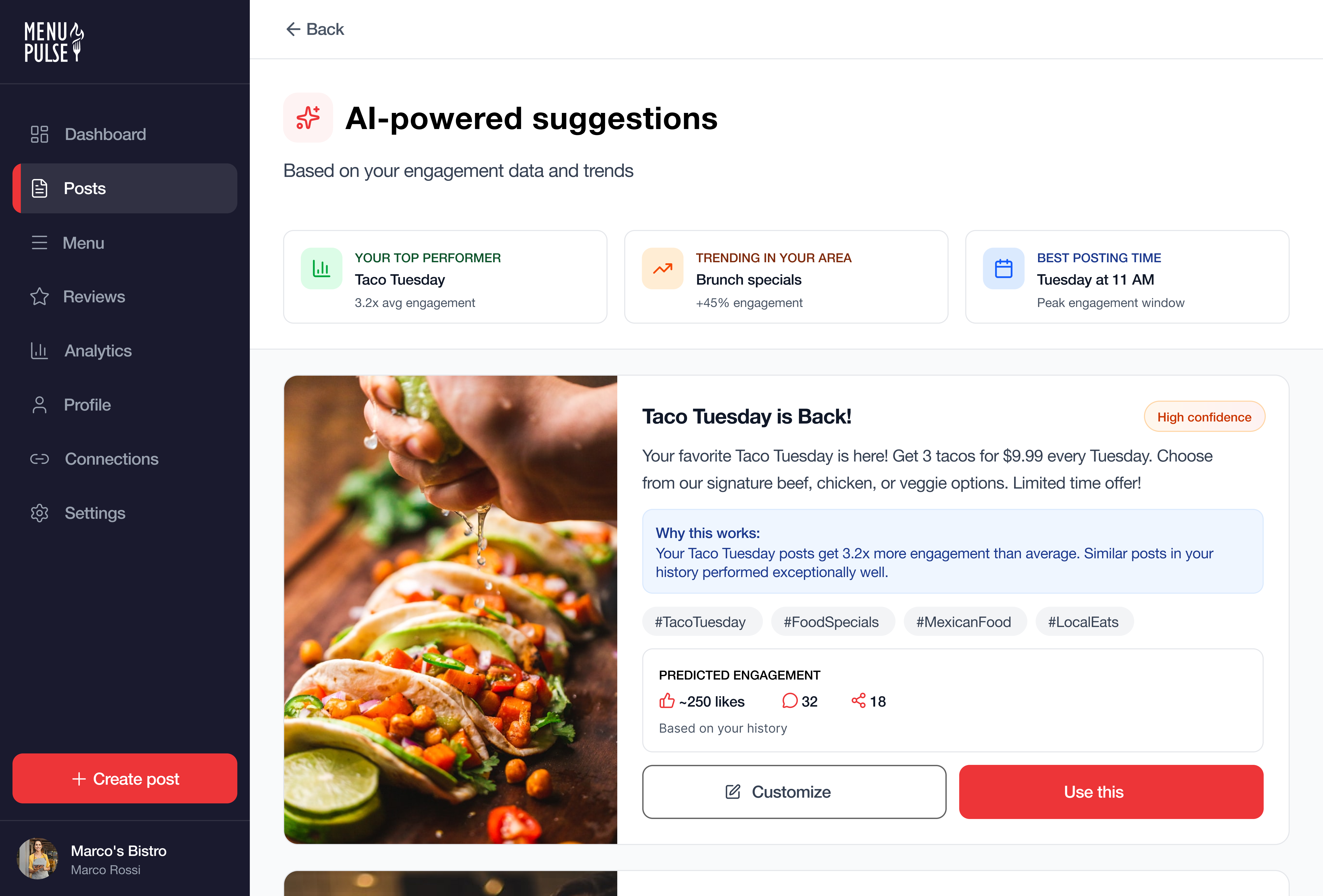
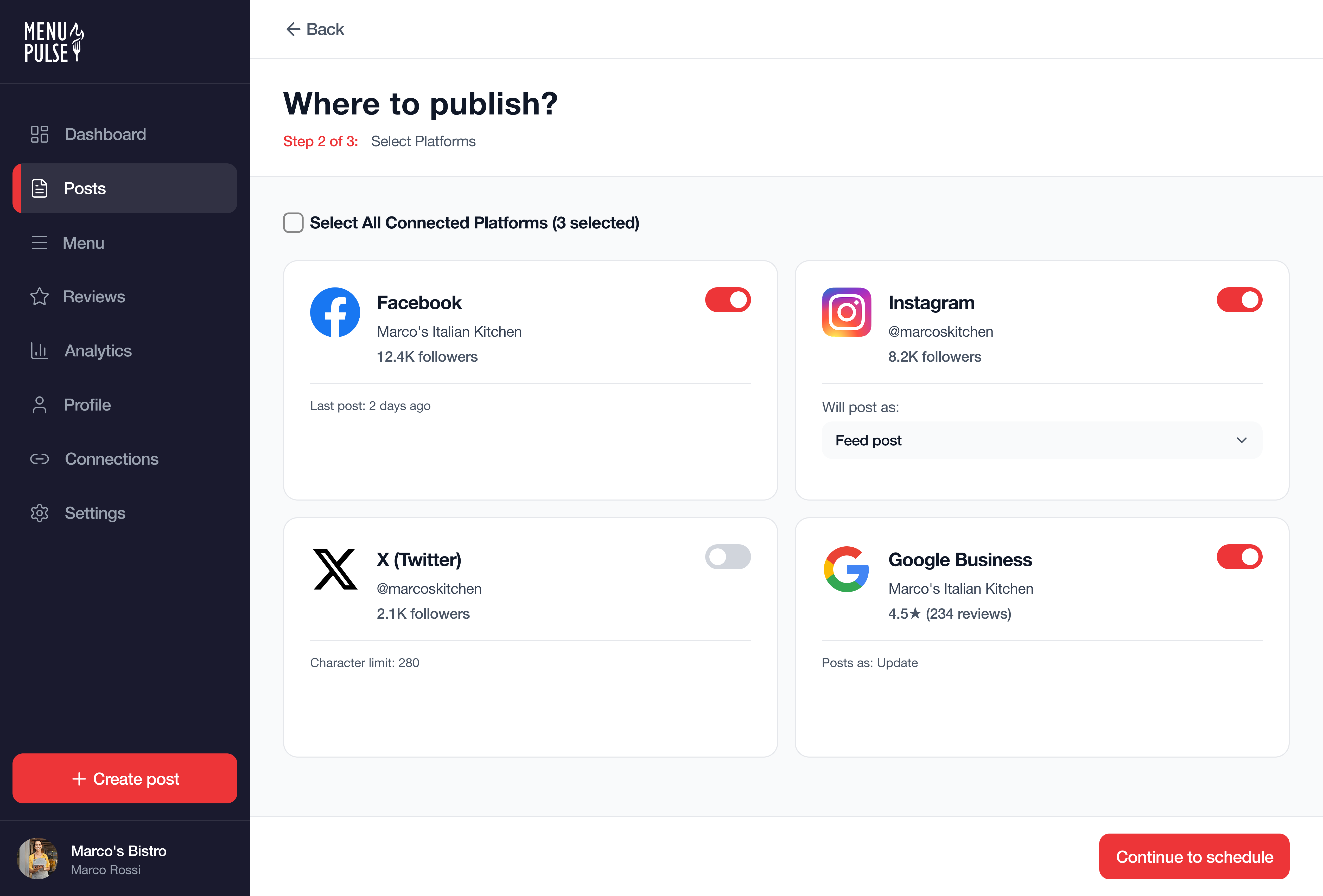
Owners posted inconsistently because they did not know what content would resonate or when to post it. Creating social content felt like one more task on an already overwhelming list.
I designed an AI-Powered Posts feature that analyzed engagement history, local trends, and optimal timing to suggest ready-to-use content. Each suggestion showed why it would work, predicted engagement, and relevant hashtags. Owners could also create posts manually with AI assist, preview across platforms, and schedule or publish instantly.
Impact: Post creation time reduced significantly. Owners engaged with 73% of AI suggestions, and scheduled posting increased consistency.
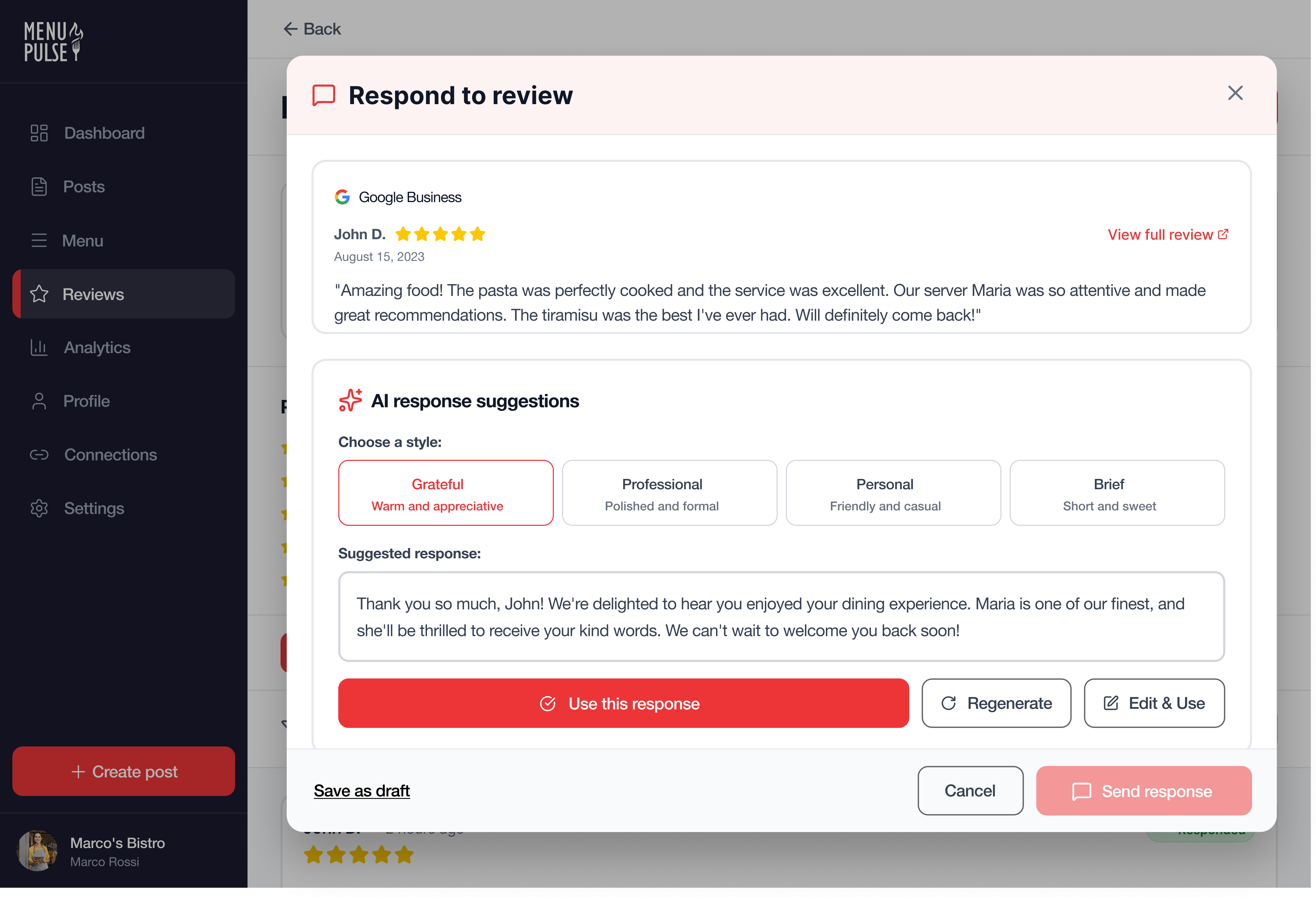
Reviews were spread across Google, Yelp, Facebook, and TripAdvisor. Owners checked each app separately, and negative reviews sat unanswered because they did not know what to say.
I designed a unified inbox that pulled reviews from all platforms into one view. When responding, owners chose from four AI response styles: Grateful, Professional, Personal, or Brief. They could use, regenerate, or edit the suggestion before sending.
Impact: Review response rate increased from 34% to 89%. Response time dropped from days to hours.
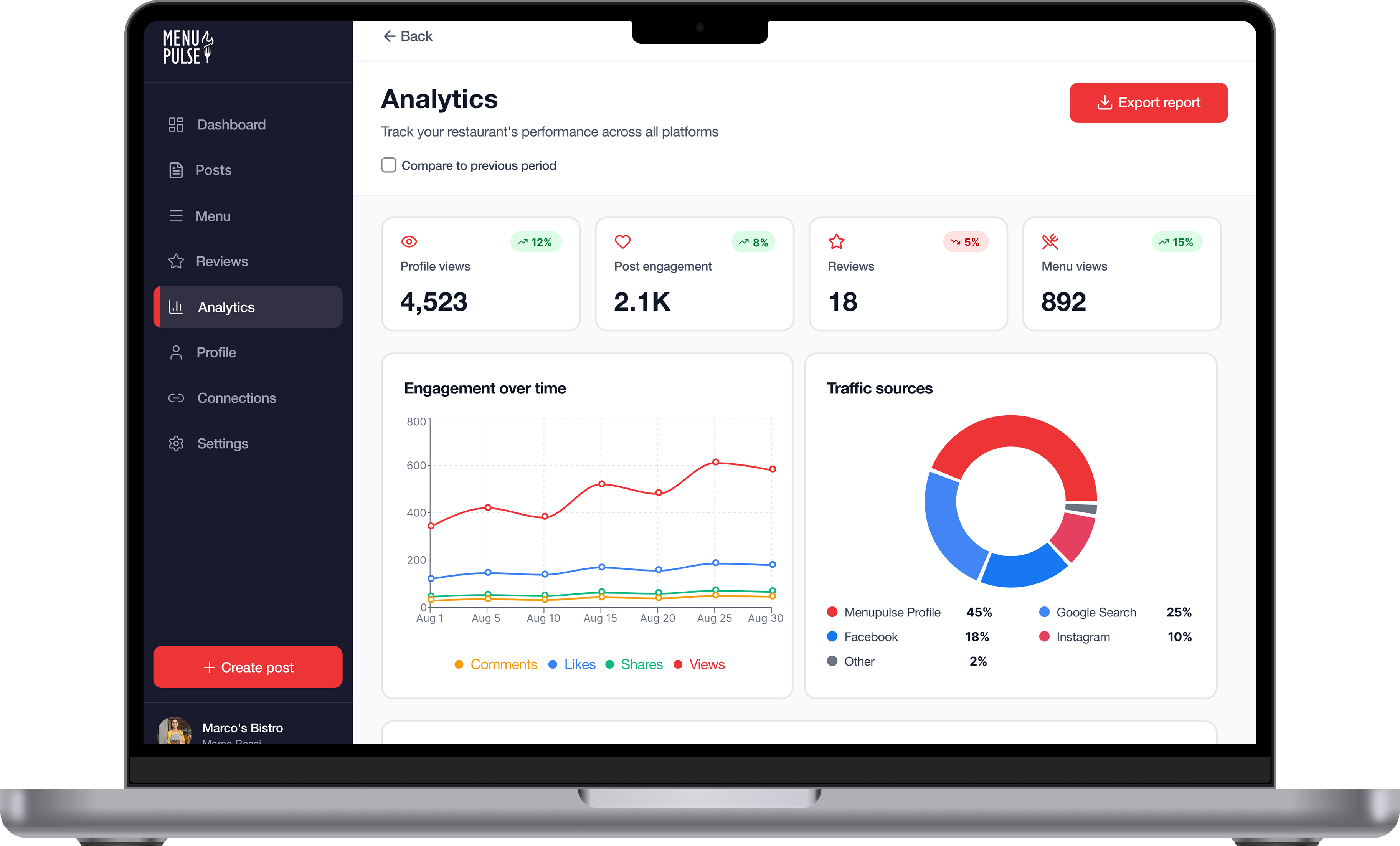
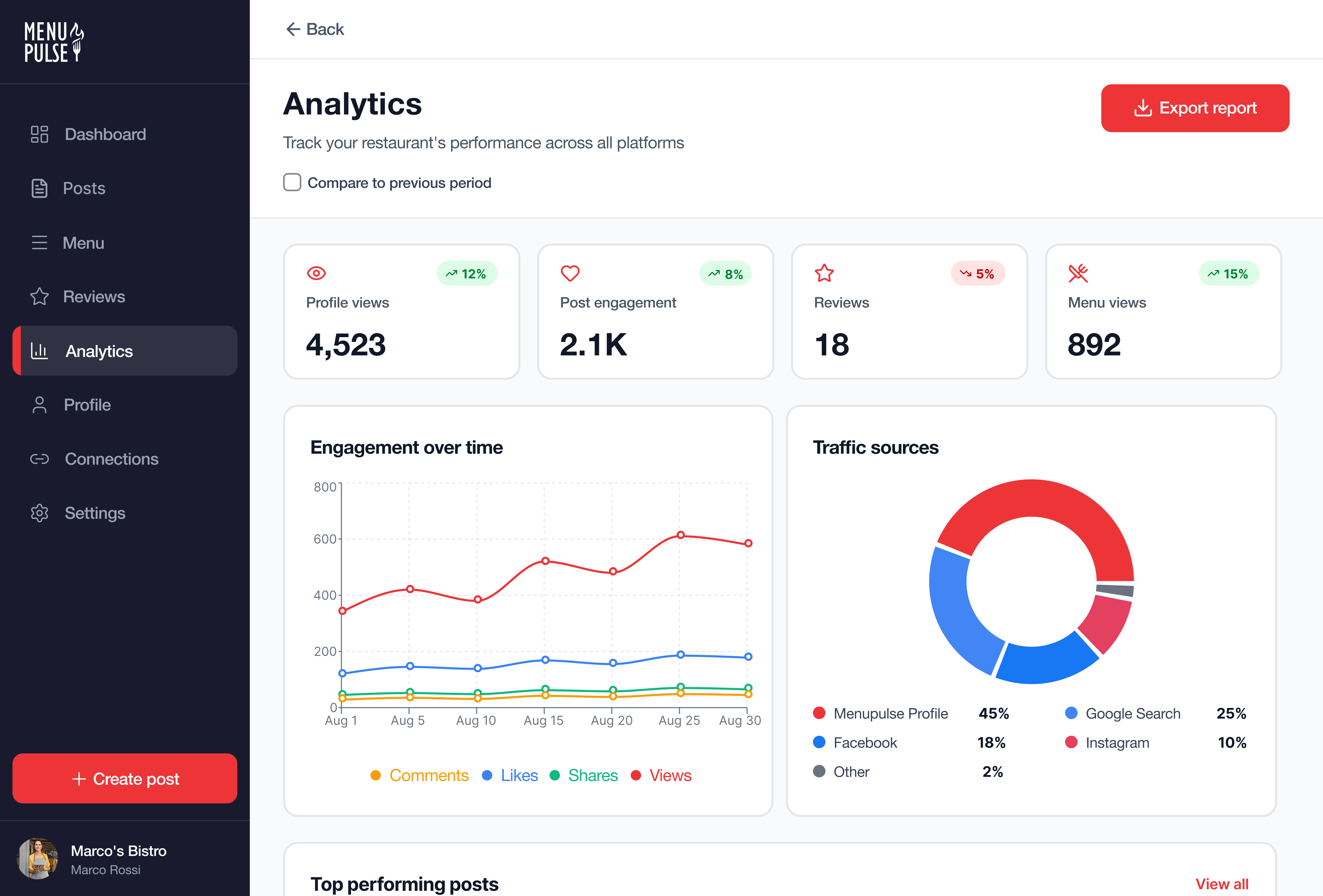
Owners had no simple way to see if their efforts were paying off. Analytics were either scattered across platforms or too complicated to interpret.
I designed a dashboard focused on four key metrics: Profile Views, Post Engagement, Reviews, and Menu Views. Trend indicators showed change over time. Engagement charts and traffic source breakdowns helped owners understand where their customers came from without drowning in data.
Impact: 68% of owners checked analytics weekly, compared to near-zero engagement with previous tools.
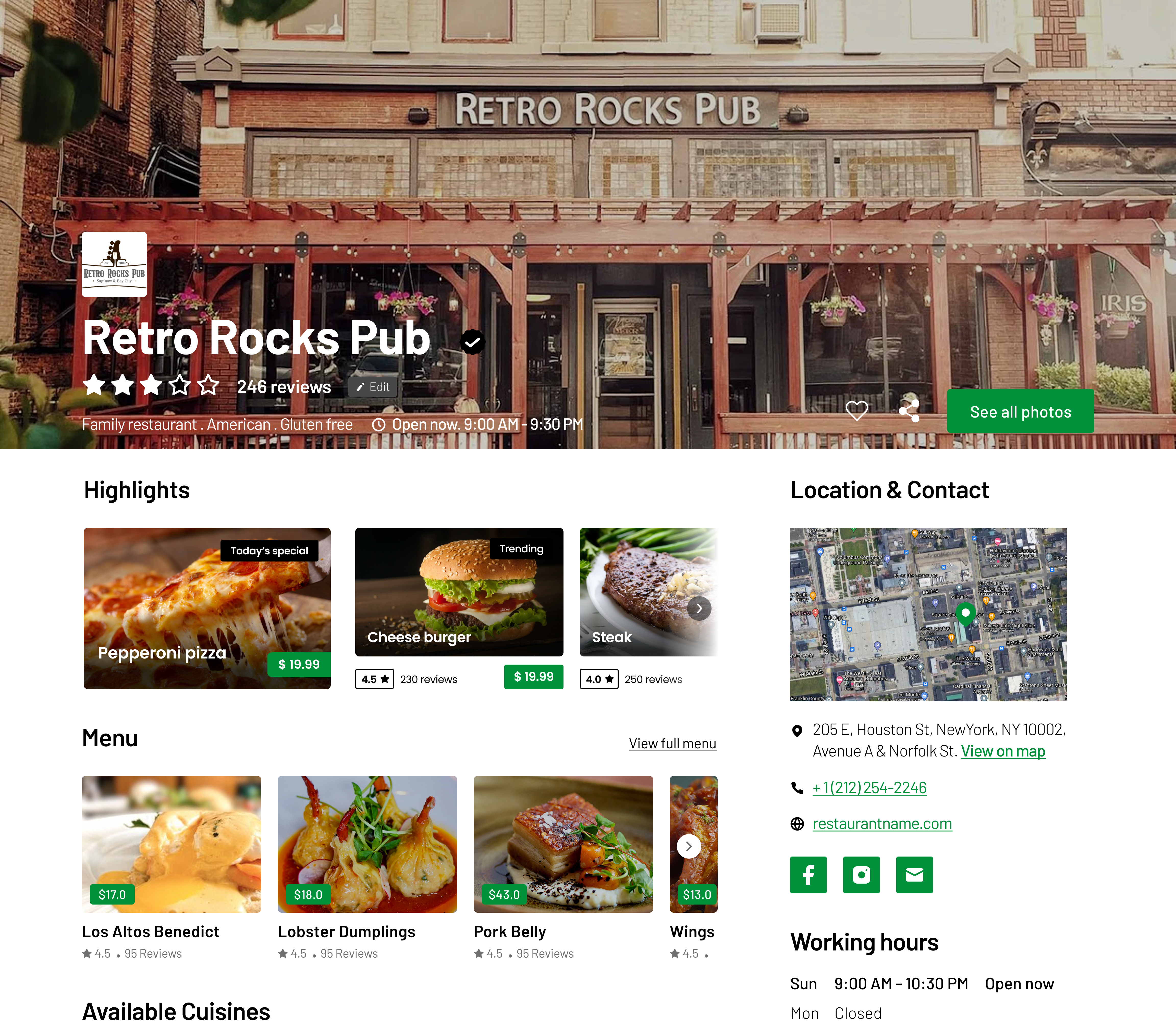
Restaurant information was scattered across platforms with inconsistent details. Diners found outdated menus, wrong hours, or conflicting prices depending on where they looked.
I designed a Public Profile, a comprehensive landing page that pulled live data from the Menu Pulse dashboard. It included the full menu, hours, location, contact information, highlighted reviews, and a Q&A section. Owners could share one link anywhere and know customers would see accurate, up-to-date information.
Impact: Profile shares increased, with owners using the link in Instagram bios, Google listings, and printed materials. Customer complaints about outdated information decreased.
After creating initial wireframes, I tested with 5 restaurant owners across 3 rounds. Their feedback fundamentally changed our approach.
Multi-step verification felt risky. Owners were unsure which account was being connected and feared losing access.
Guided wizard with visual confirmation at each step, showing exactly which account connects and what permissions are granted.
AI auto-generated responses based on review sentiment. Outputs often crossed tone boundaries, going too casual for complaints and too stiff for friendly reviews.
Four preset tones the owner selects before generation. AI writes within chosen boundaries, and the owner reviews before sending.
All locations mixed together in one view. Owners with 2–3 restaurants could not tell which data belonged where.
Location switcher in header with separate dashboards per location and option to view combined analytics.
Task completion rate improved after these three changes, from 62% to 94%.
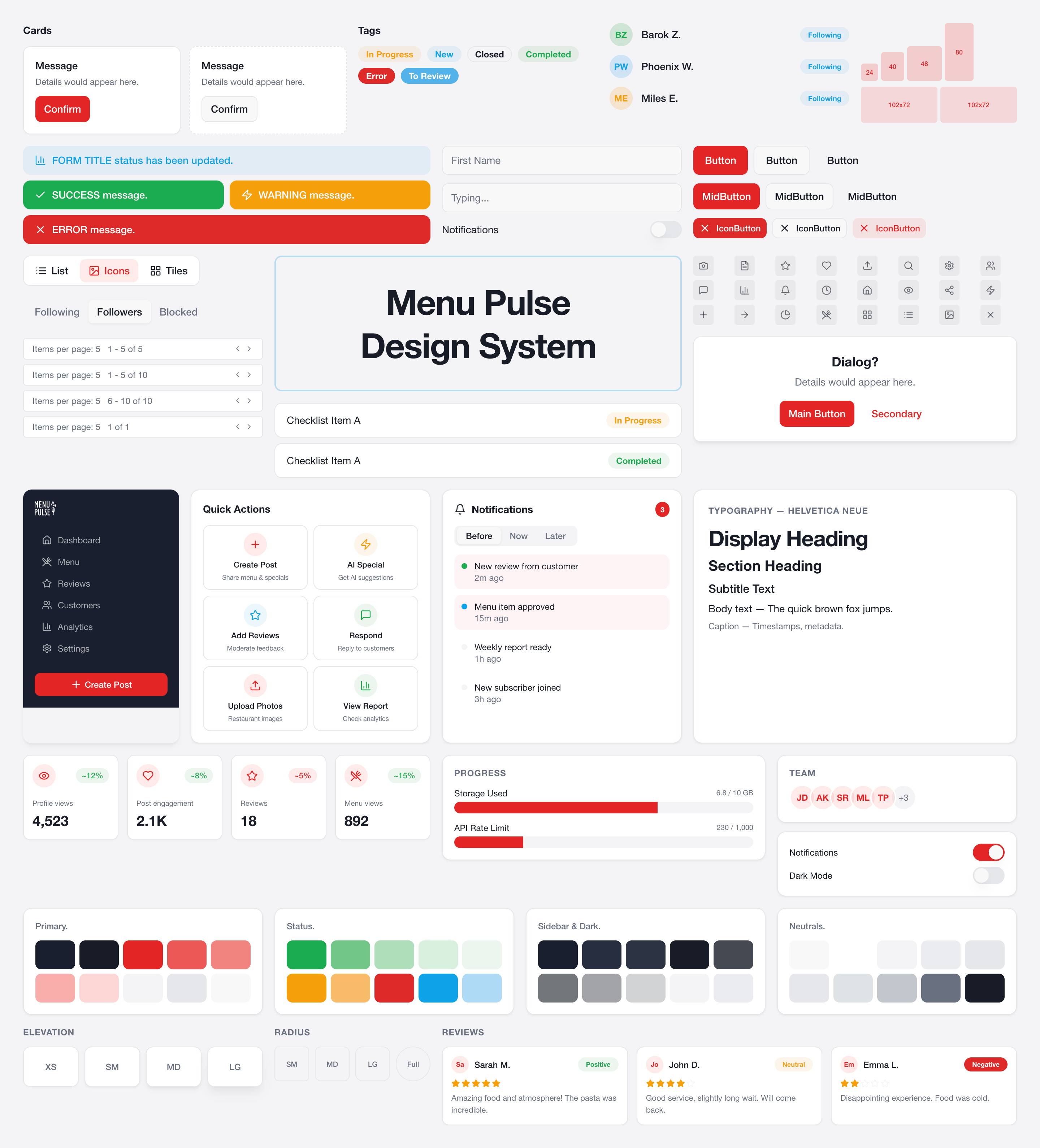
As features grew, inconsistencies crept in. Buttons looked different across screens, colors varied, and engineers kept asking "which version is correct?" I consolidated patterns into a shared system covering components, color, and typography. It gave the team a single source of truth and cut down repeated conversations.
Baseline data was collected through onboarding surveys. Post-launch metrics were tracked over 8 weeks of beta testing with 54 restaurants.
From 90 minutes to ~30 minutes per day.
From once a month to multiple times per week.
From 34% to 89% of reviews answered.
From 3.9 to 4.2 stars across platforms.
Additionally, time to first menu update reduced from 2+ hours to under 15 minutes, achieved by AI-assisted writing and simplified publishing flows.
On AI trust: Users don't want AI to decide for them. They want AI to draft, and themselves to approve. The approval step isn't friction, it's the feature.
On constraints: Showing a workaround builds more trust than hiding a limitation. Transparency became our competitive advantage.
On simplicity: The difference between monthly and weekly usage wasn't a new feature. It was three fewer clicks.
Menu Pulse started as a tool to save time. The bigger opportunity is to become the digital co-pilot for small restaurants.
The foundation is built. The next phase is about making Menu Pulse feel less like a tool and more like a team member.
